The oezpa Model
Leadership development is undergoing a fundamental transformation. Traditional seminars consisting of two days of theory and a certificate of attendance are no longer sufficient to prepare leaders for the challenges of a complex working world. Digitalisation, skills shortages, artificial intelligence, hybrid collaboration and constant change require a new form of learning.
The oezpa leadership development model therefore takes a systemic approach. The focus is not on individual training courses, but on a long-term learning architecture that combines personal development, collaboration, organisational development and practical implementation.
A particularly effective component of this model is the Company Days. They connect learning with the real organisation and create a shared understanding of value creation, collaboration and leadership.
Why traditional leadership training often falls short
Many development programmes focus on methods and tools. Leaders learn communication techniques, motivation and delegation. After just a few weeks, however, little of this is often visible in their day-to-day leadership practice.
The reason is simple: leadership does not develop through knowledge alone. It evolves through experience, reflection, relationships and active engagement with real challenges.
Sustainable leadership development requires continuous learning, practical application and shared organisational learning. This is precisely where the oezpa model comes in.
The oezpa leadership development model
The model views leadership development as a strategic component of organisational development. Its aim is not only to develop individual leaders, but also to build a shared leadership culture.
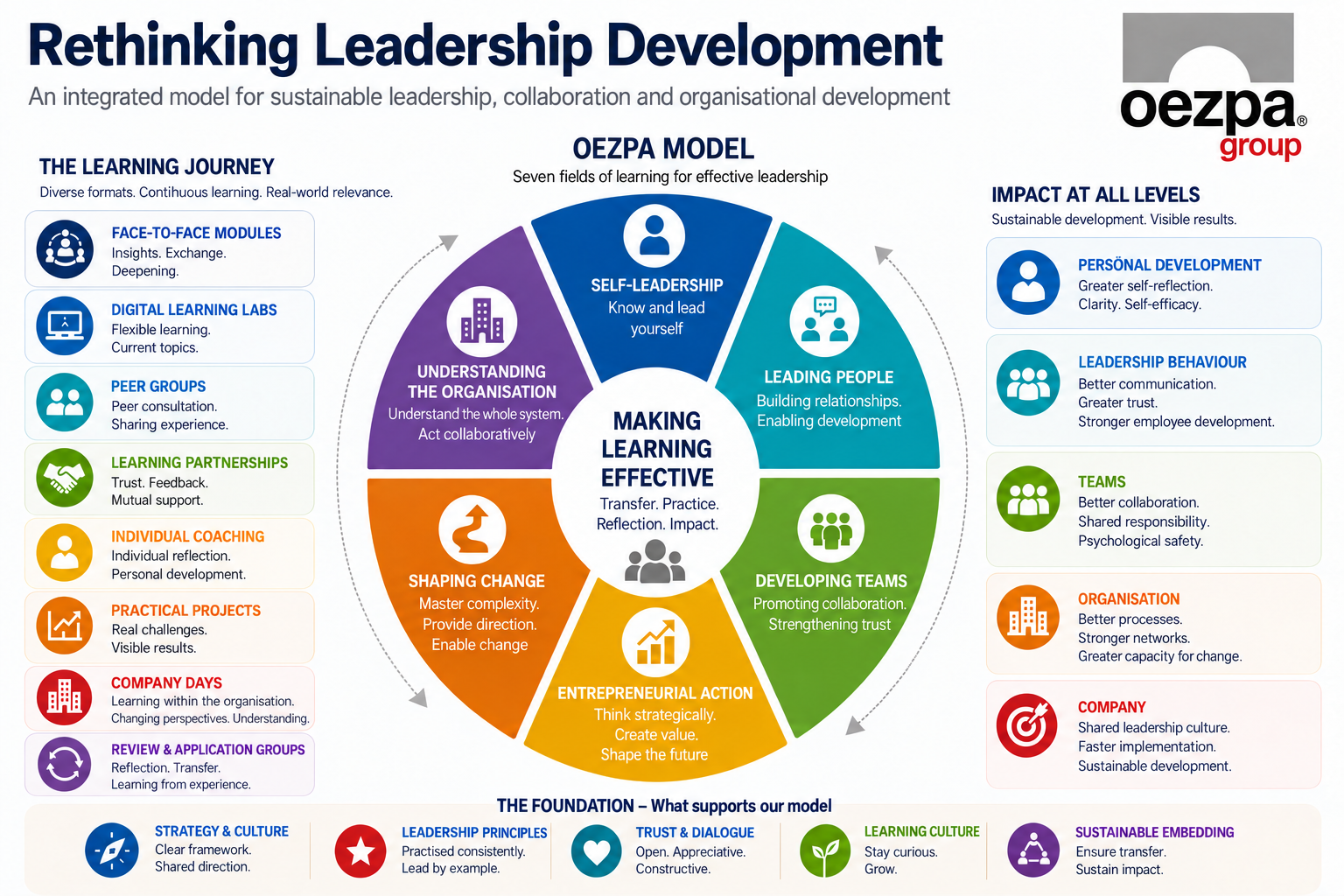
The model focuses on seven interconnected fields of learning.
Self-leadership
All leadership begins with the individual.
Leaders reflect on their values, their impact, their inner drivers and their role. They learn to remain capable of taking action in uncertain situations and to manage their own energy consciously.
The central question is: How do I lead myself?
Leading people
Successful leadership is based on relationships.
The focus is on trust, communication, feedback, coaching, delegation and employee development.
The central question is: How do I enable others to develop?
Developing teams
Teams have their own dynamics.
Leaders learn how to actively shape collaboration, use conflicts constructively, promote psychological safety and distribute responsibility within the team.
The central question is: How does genuine collaboration emerge?
Acting entrepreneurially
Leadership also means taking entrepreneurial responsibility.
This includes strategic thinking, customer orientation, an understanding of processes, innovation and commercial awareness.
The central question is: How does my area contribute to value creation?
Shaping change
Transformation is now part of everyday leadership.
Leaders therefore develop skills for dealing with complexity, uncertainty, resistance and organisational change.
The central question is: How do I provide direction when no solution is yet apparent?
Understanding the organisation
Modern companies no longer operate exclusively through hierarchies.
Successful leaders understand processes, interfaces, networks and cross-functional collaboration.
The central question is: How do I support the system as a whole?
Making learning effective
Learning does not end when the seminar is over.
Transfer, practical projects, peer consultation and continuous reflection ensure that development becomes permanently embedded in everyday leadership practice.
The central question is: What impact does my learning have on the organisation?
Company Days – learning where value is created
The Company Days are a special component of the oezpa model.
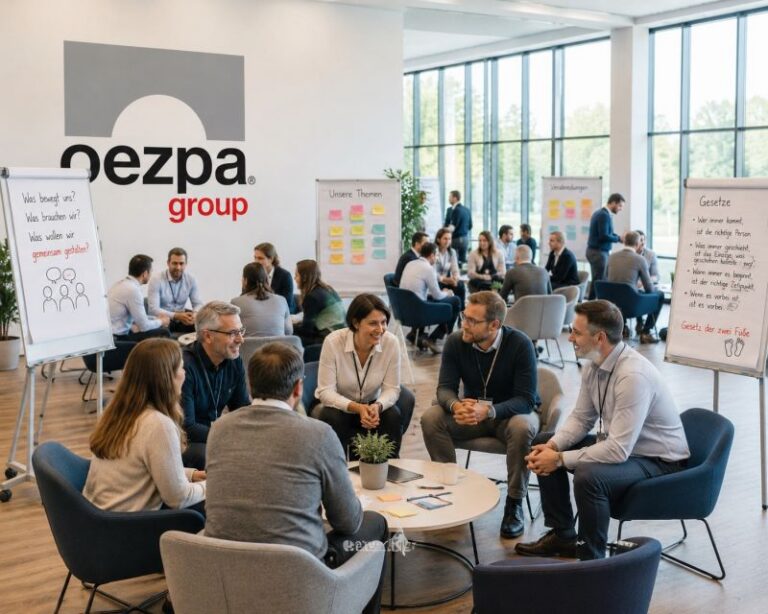
Participants deliberately leave the seminar room and learn directly within the organisation. They visit different sites and areas, such as production, sales, logistics, research and development, customer service, administration or project departments.
The aim is not simply to tour the company, but to understand the organisation.
Participants observe how value is created, which leadership challenges exist, where problems arise at interfaces, how employees experience leadership and which innovations can be transferred to their own work.
This creates a much deeper understanding of the company as a whole.
Why Company Days are so effective
Company Days connect theory with reality.
They enable cross-functional learning, encourage a change of perspective, strengthen networks, increase identification with the organisation and improve collaboration across departmental boundaries.
Above all, they create conversations that rarely take place during the normal working day. Leaders meet outside their usual roles and consequently develop new forms of cooperation.
Learning through a shared learning journey
The oezpa model does not rely on isolated events, but on a learning journey lasting several months.
It consists of face-to-face modules, digital Learning Labs, peer groups, learning partnerships, individual coaching sessions, practical projects, Company Days and reflection workshops.
Between the modules, participants conduct specific leadership experiments and evaluate them together. This allows learning to take place directly in their everyday working environment.
Practical projects connect learning and organisational development
During the learning journey, each leader works on a real-life challenge.
This may involve improving collaboration, optimising processes, introducing new ways of working, establishing a feedback culture, implementing digitalisation initiatives or carrying out cross-functional innovation projects.
As a result, both the participants and the organisation benefit.
Peer groups as a driving force for sustainable learning
Small learning groups are another key success factor.
Four to six leaders meet regularly to work on current leadership issues. Together, they reflect on difficult conversations, conflicts, change processes, personal challenges and experiences from their practical projects.
This form of peer consultation builds trust and supports sustainable behavioural change.
Leadership development as organisational development
The oezpa model does not regard leadership development as an isolated HR initiative.
Instead, it becomes an instrument of organisational development. At the same time, leadership culture, collaboration, communication, the capacity for change, innovation and cross-functional networks continue to evolve.
In this way, leaders become active shapers of organisational development.
The impact model of the oezpa model
The model creates an impact on several levels.
Leaders gain greater self-awareness and clarity about their role. Their leadership behaviour changes through improved communication, greater trust and a stronger focus on developing their employees. Teams work together with greater autonomy and develop a stronger sense of psychological safety.
At an organisational level, collaboration, processes and networking improve. In the long term, a shared leadership culture emerges, facilitating strategic change and strengthening the company’s future viability.
Leadership cannot be developed in just a few seminar days. It emerges through the combination of experience, reflection, relationships and concrete practice.
The oezpa leadership development model therefore combines personal development, teamwork, organisational development and entrepreneurial thinking within an integrated learning architecture.
The Company Days play a particularly important role in this process. They take leaders out of their familiar environment, create new perspectives on the organisation and promote cross-functional learning where value is actually created.
In this way, leadership development does not remain an isolated training initiative, but becomes a continuous development process that strengthens individuals, teams and organisations alike.
This version reads much more like a high-quality specialist article or blog post and has a more natural flow. At the same time, clear subheadings and relevant keywords ensure that it remains optimised for search engines.