We Are Running a Pilot in the Project Management Department
The demands placed on leadership have changed fundamentally in recent years. Digitalization, hybrid collaboration, increasing complexity and ever-shorter innovation cycles make one thing clear: today, a single leader can hardly be expected to have all the answers or make every decision alone.
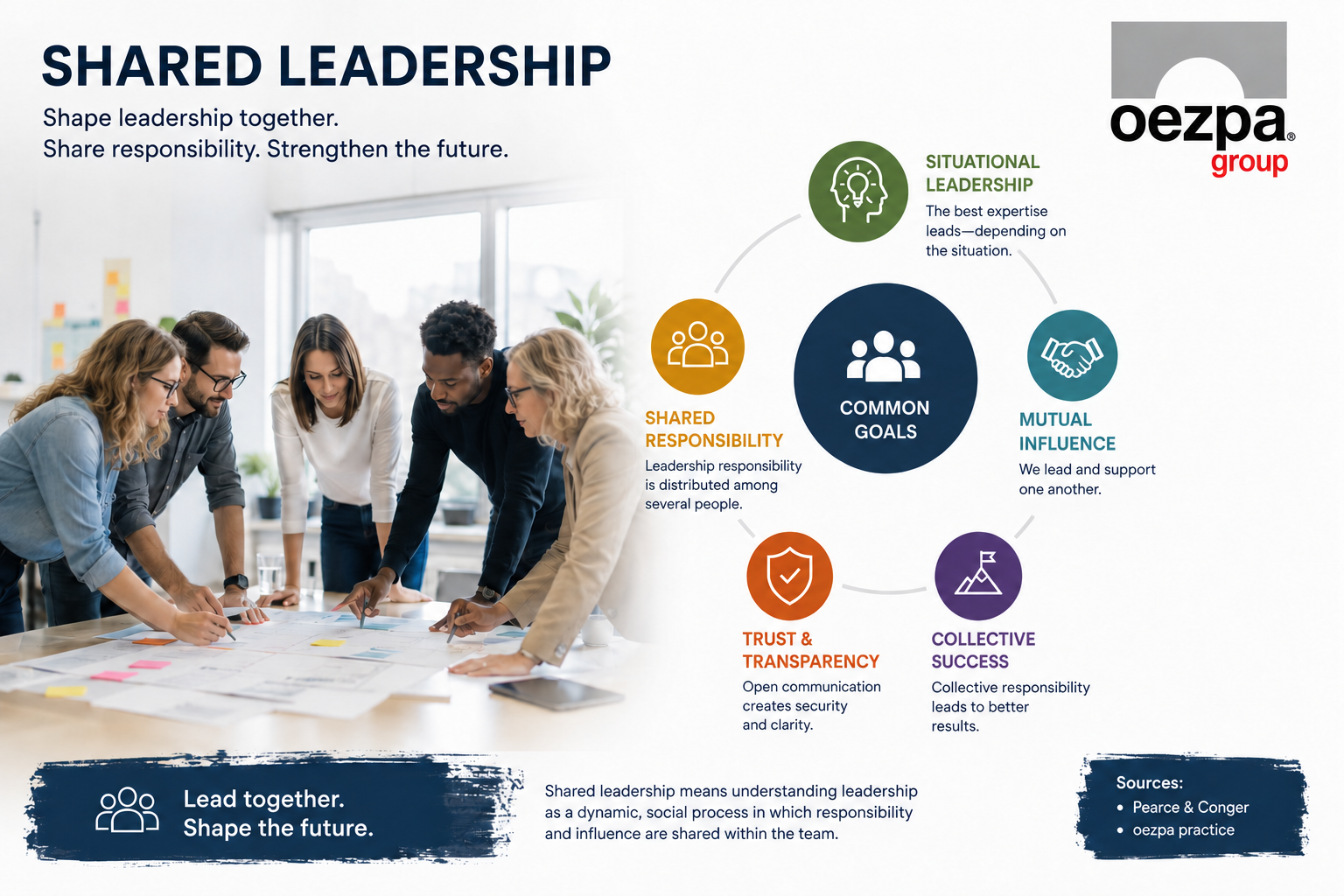
This is precisely where the concept of shared leadership comes in. The approach was developed and significantly shaped by the academic work of Craig L. Pearce and Jay A. Conger. They understand leadership not as a quality possessed by one individual, but as a social process that emerges within a team.
What Does Shared Leadership Mean?
Shared leadership refers to the deliberate distribution of leadership responsibility among several people within a team. Depending on the situation, the person with the greatest expertise, most relevant experience or best-suited skills assumes the leadership role.
The formal leader does not disappear. Instead, their role changes fundamentally: they provide direction, establish the framework, strengthen trust and enable others to take responsibility.
Leadership thus becomes a collective capability of the team.
Why Is Shared Leadership Becoming More Important?
The world of work is increasingly moving towards knowledge-based work. Decisions often need to be made where the relevant expertise is located—not necessarily at the highest level of the hierarchy.
Today, organizations need:
- faster decision-making
- greater capacity for innovation
- higher levels of individual responsibility
- better collaboration across departmental boundaries
- greater adaptability to change
Shared leadership supports precisely these requirements.
The Five Core Principles
Shared Responsibility
Leadership is not monopolized. Several people assume responsibility for different topics and situations.
Situational Leadership
Leadership is determined not by position, but by competence, experience and context.
Mutual Influence
Team members support, advise and lead one another. Leadership takes place not only vertically, but also horizontally.
Trust and Transparency
Shared leadership can only work where trust exists and information is shared openly.
Common Goals
Everyone involved works towards a common purpose rather than pursuing individual interests or remaining within departmental boundaries.
What Role Does the Formal Leader Play?
A common misconception is that shared leadership means less leadership.
The opposite is true.
The formal leader assumes a more demanding role. They must:
- provide direction
- create a sense of purpose
- facilitate conflict resolution
- enable decision-making
- clarify responsibilities
- develop talent
- shape collaboration
They lead less through instruction and more through designing an effective system.
Benefits of Shared Leadership
Organizations frequently report:
- greater capacity for innovation
- higher employee engagement
- better use of existing expertise
- faster problem-solving
- greater individual responsibility
- an enhanced capacity for learning
- greater adaptability
- stronger identification with shared outcomes
Particularly in project-based organizations, agile teams and matrix structures, experience shows that complex challenges can often be addressed more effectively through collective leadership.
The Challenges
Shared leadership is not self-sustaining.
Without clear conditions and structures, new problems may arise:
- Responsibilities become unclear.
- Decisions take longer.
- Conflicts are not addressed.
- Some individuals permanently assume too much responsibility.
- Others withdraw.
Shared leadership therefore requires clear rules and the conscious management of collaboration.
What Organizations Need
For shared leadership to work, several prerequisites must be met:
Psychological Safety
Employees must be able to express their opinions openly without fear of negative consequences.
Trust
Responsibility can only be shared where mutual trust exists.
Clear Roles
Even when leadership is shared, responsibilities must remain clearly defined.
Competence Development
Employees need skills in communication, self-organization, conflict resolution and decision-making.
Common Goals
A shared understanding of what is to be achieved prevents competition between departments.
The Role of Organizational Coaching
Introducing shared leadership is far more than an organizational change. It challenges established perceptions of roles, power structures and ways of thinking.
Systemic-psychodynamic organizational coaching can support organizations in:
- making existing leadership patterns visible
- reflecting on implicit expectations of leadership
- addressing power and role dynamics
- building trust between leaders and teams
- handling conflicts constructively
- promoting psychological safety
- developing leadership teams’ ability to collaborate
- sustainably embedding a culture of shared responsibility
Transformation processes in particular demonstrate that shared leadership is less a method than a form of cultural development.
Shared leadership does not replace the traditional leader. It broadens our understanding of leadership. The formal leader remains accountable while consciously distributing responsibility to those who can make the greatest contribution in a particular situation.
Organizations that harness collective intelligence, share responsibility and foster trust often develop a greater capacity for innovation, increased adaptability and stronger employee engagement.
In an increasingly complex world, leadership is becoming less the achievement of individuals and more the capability of an entire team.
Sources
Pearce, C. L. / Conger
Özdemir, H. / Lagler Özdemir, B., Change Management Practice
Özdemir, H. / Lagler Özdemir, B., Organizational Coaching
oezpa practice