orgLAB & orgCAMP 2026
On 16–17 October in Cologne, we will be training leaders, HR professionals, consultants, professionals, trainers and coaches at orgLAB & orgCAMP.
Why Do Good Teams Fail Despite Having Good People?
Many leaders look for the causes in processes, structures or a lack of competence.
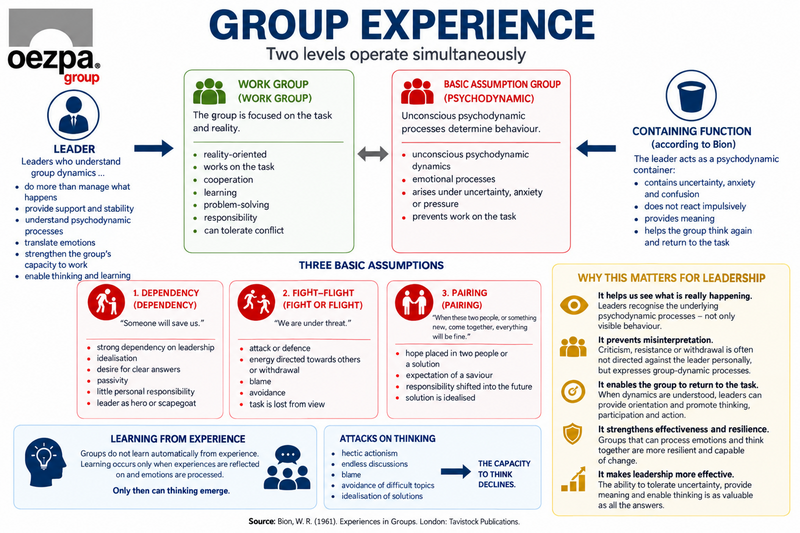
In his classic work Experiences in Groups, however, Wilfred Bion offers a different perspective: teams never work solely on their task. They are always working on their emotions as well.
Alongside the visible Work Group, which focuses on goals, decisions and problem-solving, a second level exists simultaneously: the Basic Assumption Group. At this level, unconscious psychodynamic processes such as uncertainty, dependency, hope and anxiety are at work – and they often influence behaviour more strongly than rational arguments.
This Explains Why Teams Sometimes…
… repeatedly have the same discussions.
… delegate responsibility to leadership.
… look for someone to blame instead of developing solutions.
… place their hopes in the “new boss” or the “next project”.
… lose sight of their actual task despite having a high level of competence.
For oezpa, this is one of the most important insights of modern leadership.
Leadership does not simply mean setting goals or making decisions. Effective leadership recognises what is happening beneath the surface. It helps teams tolerate uncertainty, process emotions and regain their collective capacity to think.
This is precisely where systemic psychodynamic organisational coaching comes in. It considers not only what happens in collaboration, but also how it happens. It makes unconscious dynamics visible, helps leaders understand them and strengthens teams’ ability to remain effective even under pressure.
In an era of increasing complexity, this capability is becoming a decisive competitive advantage. Sustainable change is not achieved through new strategies or processes alone – it becomes possible when people are able to think, learn and act together.
Those who understand groups lead organisations more effectively.