Summary
Most leadership challenges are not only about strategy, structures or processes.
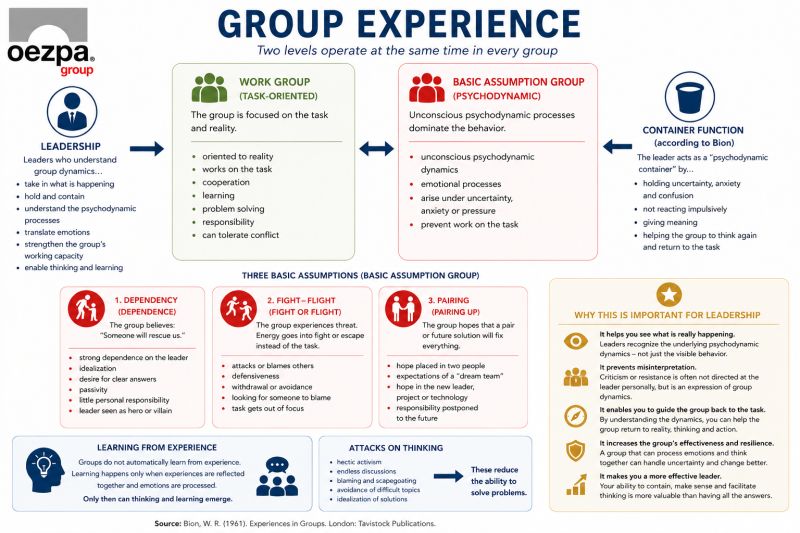
They are also about what happens beneath the surface. More than 60 years ago, Wilfred Bion described a powerful insight in Experiences in Groups: every group operates on two levels at the same time.
The Work Group focuses on tasks, collaboration and problem-solving.
At the same time, the Basic Assumption Group is influenced by unconscious psychodynamic processes such as anxiety, dependency, conflict or unrealistic hope. Under pressure, these hidden dynamics often become more powerful than the actual task.
This perspective fundamentally changes how we understand leadership.
Resistance is not always resistance.
Conflict is not always personal.
Silence does not necessarily mean agreement.
Beneath visible behaviour, there are often invisible group dynamics waiting to be understood.
One of Bion’s most valuable ideas is the containing function of leadership. Effective leaders do more than simply provide answers. They create a space in which uncertainty can be contained, emotions can be processed and the group can regain its ability to think together.
In our experience in executive coaching and organisational consulting, leaders who understand group dynamics make better decisions, interpret difficult situations more accurately and build teams that remain effective even under pressure.
Understanding psychodynamic processes is therefore not a “soft” issue. It is a strategic leadership capability.
Source: Bion, W. R. (1961). Experiences in Groups and Other Papers. London: Tavistock Publications.
oezpa Specialist Article
Experiences in Groups According to Bion – Why Leadership Is Far More Than Management
“Groups never work only on their task. They are always working on their emotions as well.”
This idea by the British psychoanalyst Wilfred R. Bion may seem surprising at first. After all, companies invest a great deal of time in strategies, processes, role descriptions and target agreements. Leaders attend seminars on communication, delegation and motivation. Teams optimise workflows, define responsibilities and establish agile ways of working.
And yet many organisations repeatedly experience the same phenomena:
A project stalls even though everyone involved is professionally competent. Leadership teams spend hours discussing issues without making decisions. Changes encounter resistance even though they are understandable. New leaders are initially idealised and later heavily criticised. Conflicts arise between departments even though everyone is pursuing the same corporate objective.
What lies behind this?
In his work Experiences in Groups (1961), Wilfred Bion provides an explanation that is more relevant today than ever.
Every Group Exists on Two Levels
According to Bion, two realities exist simultaneously in every group.
The first is visible. He calls it the Work Group. At this level, people engage with their actual task. They analyse problems, develop solutions, take responsibility and make decisions. Collaboration is task-oriented, learning is possible and conflicts are addressed constructively.
At the same time, however, a second level is at work and often remains unnoticed: the Basic Assumption Group.
At this level, unconscious psychodynamic processes determine the group’s behaviour. Anxiety, uncertainty, hope and unconscious expectations often influence decisions more strongly than rational arguments.
This second level becomes particularly significant during periods of great uncertainty.
Why This Matters for Companies
Organisations often see themselves as rational systems. In reality, however, they consist of people – and people bring emotions, hopes, fears and relationship patterns with them.
The greater the pressure for change, the more strongly these dynamics emerge.
Mergers, restructuring, digitalisation, cost-cutting programmes and strategic realignment create uncertainty. Employees ask themselves:
- What does this mean for me?
- Am I still important?
- Will my department continue to exist?
- Can I trust the leadership?
These questions are often not expressed. Nevertheless, they influence behaviour.
Resistance to change therefore frequently arises not from a lack of understanding, but from emotional uncertainty.
Anyone who focuses exclusively on processes, organisational charts or communication plans overlooks a significant part of organisational reality.
Why This Is Crucial for Leaders
Many leaders experience situations in which they ask themselves:
- Why do our discussions keep going round in circles?
- Why does no one take responsibility?
- Why is so much criticism suddenly directed at me?
- Why is a relatively minor problem escalating?
Bion’s model helps us interpret these situations differently.
Not every criticism is directed at the leader personally.
Leaders often unconsciously become a projection screen for the fears and uncertainties of the entire group.
Those who recognise this respond differently.
Instead of reacting defensively or looking for someone to blame, the leader can try to understand the underlying dynamic.
This fundamentally changes leadership.
Leadership is then no longer exclusively about providing answers.
Above all, leadership means protecting the group’s capacity to think.
Why Leadership Teams Are Particularly Affected
Executive boards and leadership teams are also subject to these dynamics.
Unconscious patterns frequently arise wherever there is intense economic pressure.
An executive board waits for the “strong CEO” who will solve every problem. Divisional leaders begin blaming one another for difficulties. Decisions are repeatedly postponed in the hope that the situation will improve on its own or that the next strategy will solve everything.
From the outside, such leadership teams often appear indecisive or conflict-ridden.
From a psychodynamic perspective, however, they are frequently attempting to deal with collective uncertainty.
This perspective opens up new possibilities for leadership development.
The Three Basic Assumptions
Bion describes three typical patterns of response.
Dependency
The group unconsciously believes:
“Someone will save us.”
Responsibility is delegated entirely to the leader.
The leader is either idealised or later turned into a scapegoat.
Fight–Flight
The group experiences a threat.
Instead of working on the task, it invests its energy in conflict, defence, blame or withdrawal.
The actual task is lost from view.
Pairing
Hope is placed in two people or in a future solution.
“When the new CEO arrives …”
“When the new system has been introduced …”
“When these two start working together …”
Responsibility is shifted into the future.
How Can Such Dynamics Be Recognised?
Psychodynamic processes are rarely visible directly.
Instead, they become apparent through recurring patterns.
Typical indications include:
- the same conflicts occur repeatedly
- decisions are continually postponed
- individuals are idealised or devalued
- rumours spread faster than information
- responsibility is avoided
- discussions go round in circles
- the group loses sight of its actual task
- conspicuous harmony prevents necessary conflict
- factions or coalitions emerge
- new solutions are instinctively rejected or exaggerated
Such patterns are often more important than individual statements.
Organisational coaches therefore observe not only what is said, but also how, by whom, when and with what effect it is said.
What Can Leaders Do in Practice?
The first step is to notice the dynamic rather than trying to intervene immediately.
Helpful questions include:
- What is the group really working on at this moment?
- What emotion might lie behind this behaviour?
- What is not being said?
- What unspoken expectations are being directed at me?
- What responsibility is the group taking – and what is it delegating to others?
Leaders do not have to resolve every emotion.
They should, however, create a space in which uncertainty can be expressed.
Bion refers to this as the containing function.
The leader tolerates tension, avoids reacting too quickly and helps the group organise its thoughts. This restores the ability to think together and work on the actual task.
What Role Do Organisational Coaches Play?
Organisational coaches work not only with individuals, but also with the relationships and dynamics within the system.
They observe patterns of interaction, reflect unconscious processes and help leaders understand what is happening from a different perspective.
Instead of suggesting solutions too quickly, they ask questions such as:
- What function might this conflict be serving?
- Who is taking on which role within the group?
- What unspoken expectations are at work?
- Which fears are influencing decisions?
- What is the team actually working on – the task or its uncertainty?
This creates a shared space for reflection.
Organisational coaches support leaders in:
- recognising psychodynamic patterns at an early stage,
- not taking projections personally,
- understanding conflicts systemically,
- refocusing attention on the shared task,
- creating sustainable spaces for communication,
- promoting psychological safety,
- providing emotional support during change processes, and
- strengthening teams’ collective capacity to think.
Particularly in executive teams and transformation projects, their contribution is not to make decisions, but to create the conditions under which good decisions become possible again.
Wilfred Bion’s work has lost none of its relevance. On the contrary: the more complex organisations become, the more important it is to understand their unconscious dynamics.
Companies are not only economic systems, but also social and emotional systems. Leadership therefore means far more than target agreements, key performance indicators or processes. It means providing direction, tolerating uncertainty and creating spaces in which collective thinking remains possible.
Especially in an era of constant change, the success of an organisation is not determined solely by the quality of its strategy. It also depends on how effectively leaders and teams deal with uncertainty, emotions and the psychodynamic processes that shape every group – whether visibly or invisibly.
References
Bion, W. R. (1961). Experiences in Groups and Other Papers. London: Tavistock Publications.
French, R., & Vince, R. (Eds.). (1999). Group Relations, Management, and Organization. Oxford University Press.
Gabriel, Y. (1999). Organizations in Depth: The Psychoanalysis of Organizations. Sage.
Hirschhorn, L. (1997). Reworking Authority: Leading and Following in the Post-Modern Organization. MIT Press.
Obholzer, A., & Roberts, V. Z. (Eds.). (1994). The Unconscious at Work: Individual and Organizational Stress in the Human Services. Routledge.
Özdemir, H., & Lagler Özdemir, B. (2024). Organisationscoaching. Vandenhoeck & Ruprecht Verlag.
Schein, E. H., & Schein, P. (2021). Humble Leadership. Berrett-Koehler.