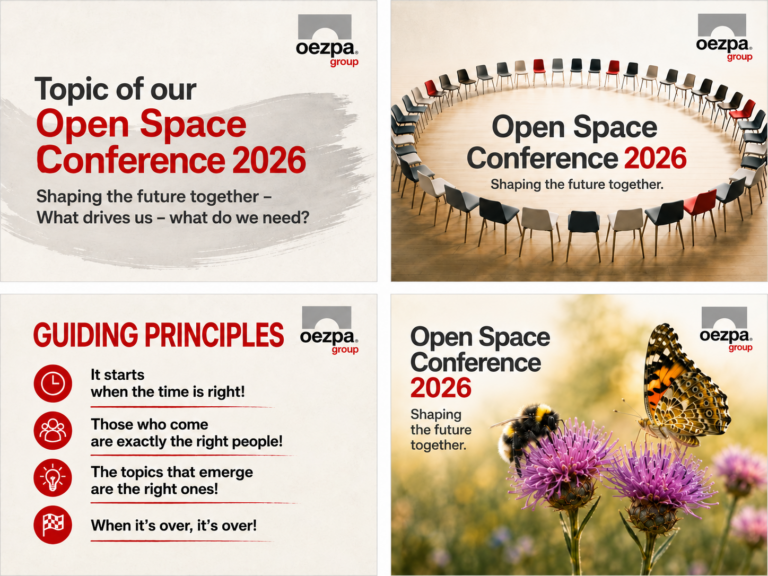
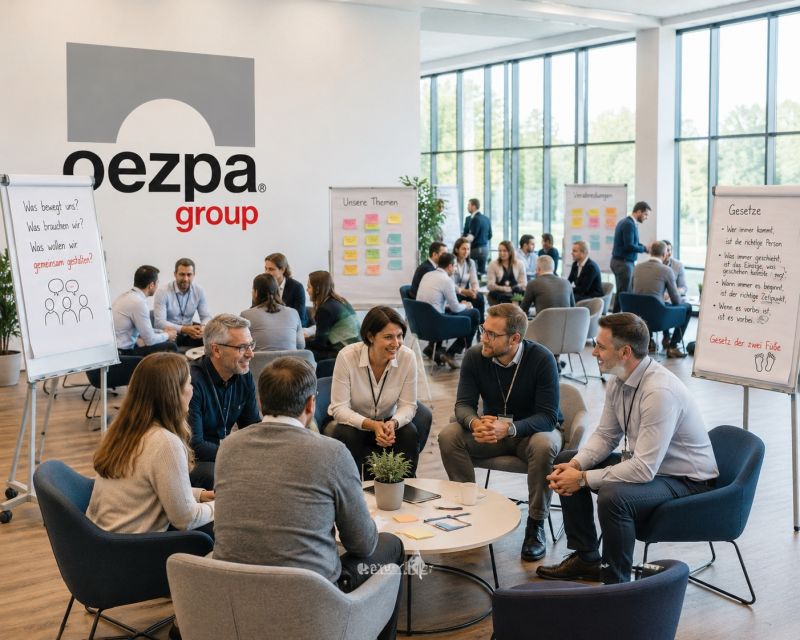
An Open Space Conference thrives on the self-organisation of its participants. This is precisely why facilitation plays such an important role. Its task is not to prescribe content, but to create a framework in which people take responsibility, engage in dialogue and jointly develop viable solutions.
Effective facilitation begins with a clear introduction. Participants need to understand why there is no predetermined agenda, why they are expected to contribute their own topics and why self-organisation is not a risk, but a major opportunity. Open Space can only unfold its full potential once trust in the process has been established.
The attitude of the facilitators is equally important. They approach the group with trust, openness and curiosity. They remain neutral regarding the content, observe the process attentively and intervene only when support is needed. Responsibility for the content and outcomes remains with the participants at all times.
Another key success factor is consistently protecting the principles and laws of Open Space. This applies in particular to the Law of Two Feet. Participants are explicitly encouraged to move to another group if they are neither learning nor able to make a meaningful contribution where they are. This creates new connections, fresh perspectives and the transfer of knowledge across departmental boundaries.
The so-called “bees” and “butterflies” also deserve special attention. These are roles that participants may adopt. While bees carry ideas between the working groups, butterflies and their informal conversations often generate unexpected impulses and innovations. Effective facilitation deliberately creates space for both forms of exchange.
It is particularly valuable when tensions and differing points of view are not resolved too quickly. Different perspectives often reflect important organisational issues. The role of facilitation is to enable respectful dialogue and support the group in using these differences productively.
Finally, the facilitators ensure that good conversations lead to concrete results. Insights are documented, responsibilities are assigned and next steps are agreed. In this way, an inspiring dialogue becomes a sustainable development process.
Our experience from numerous large-group events shows that the most effective facilitation is often the kind that is barely noticed. It provides orientation, security and trust – and enables the people in the room to use their collective intelligence for the future of their organisation.